Velocity Grid Transformations in ArcGIS


Coordinate reference systems and datum transformations are one of those GIS fundamentals that usually ‘just work’, right up until they don’t. Well, we all assumed it just worked, but not always in the way we thought. “Just use the first transformation on the list” isn’t a scientific approach, but thankfully, the software did attempt to guide us. However, the software could only do so much, especially when the best transformations weren’t even an option.
While the implications are broad, the real impact is felt most strongly in Canada, where modern datum management relies heavily on velocity-based transformations. We will focus on NAD83(CSRS) NTv2 velocity grid transformations since these are the first ones to be implemented in ArcGIS Pro 3.6, but more are coming in future releases.
A Quick Recap: Why CSRS Transformations Were a Problem
For anyone working with Canadian data, transformations between NAD83 CSRS realizations have always been a bit uncomfortable in ArcGIS (or any desktop GIS). For years, we’ve known the issue: NRCan moved to NTv2 velocity grid transformations for later CSRS re-adjustments, but ArcGIS didn’t support velocity grids. That left GIS users in an awkward position. We either accept partial transformation support or resort to external tools like NRCan’s TRX when accuracy of transformations really mattered.
That finally changed.
With ArcGIS Pro 3.6, Esri has added support for velocity grid transformations, aligning ArcGIS Pro with modern geodetic practice. In this initial release, Esri leveraged NRCan’s publication of velocity grids to make them the first ones to use this new approach in GIS software.
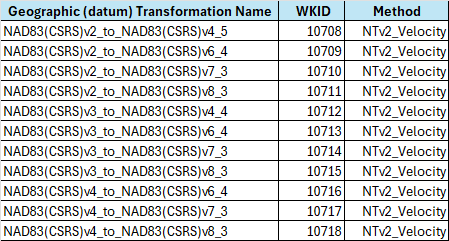 This table lists all the transformations based on the new NTv2 velocity grid approach in Pro 3.6
Blame Canada?! Nah, we are just fashionably late early:
NRCan defines transformations between NAD83(CSRS) realizations using NTv2 velocity grids, not traditional static NTv2 grids. These velocity grids account for crustal motion over time and are essential for more accurate transformations between CSRS versions.
Until recently, desktop GIS software had some related limitations:
- No support for published NTv2 velocity grids;
- Many CSRS realization transformations were not available;
- Results between GIS transformations and NRCan’s TRX tool didn’t align for NAD83(CSRS) realizations;
- EPSG didn’t even register these transformations until March 2024;
In short, the math existed, but ArcGIS Pro couldn’t leverage the file format. Side note as of writing: this still isn’t available in QGIS yet.
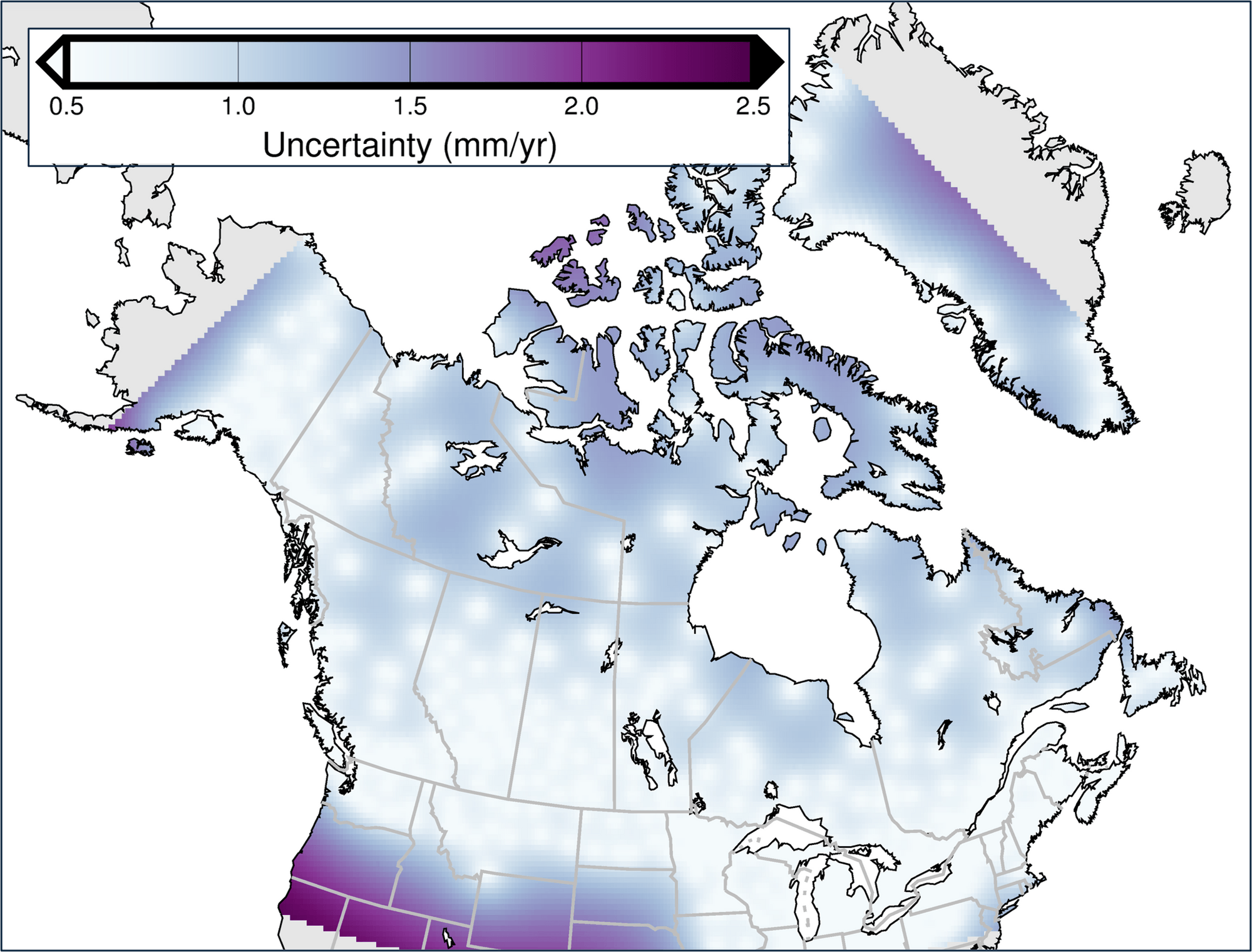 NAD83v80VG East Uncertainty Map ~NRCan
What Changed in ArcGIS Pro 3.6
As of ArcGIS Pro 3.6, Esri has implemented support for velocity grid transformations using the published NRCan NTv2 velocity grids. Specifically:
- ArcGIS Pro now supports transformations between NAD83(CSRS) v2 through v8;
- These transformations use the latest velocity grid, NAD83v80VG.gsb;
- The required grid files are included via the ArcGIS Coordinate System Data installer;
- Transformations are available directly through standard ArcGIS Pro projection workflows;
This is a big deal. It means ArcGIS can now perform the same class of transformations NRCan has been promoting for years.
 ArcGIS Pro using a 2-step transformation including a NTv2 Velocity Grid
Why This Matters
This update closes a long-standing gap for datum transformations in the software:
- ArcGIS Pro can now perform modern, authoritative velocity grid transformations;
- Aligns with EPSG registered definitions;
- Is the first phase to supporting NATRF2022 migrations in North America;
- Differences between ArcGIS and NRCan transformations are effectively eliminated (at the anchor epoch);
- No more awkward disclaimers in project documentation (because we were all doing that… RIGHT?!);
This is also a first, and critical step for ArcGIS Pro as we get closer to the release of the North American Terrestrial Reference Frame of 2022 (NATRF2022). Moving from older NAD83 projections into more modern systems of NAD83(CSRS) or NATRF2022 will be possible with this enhancement and expansion over time.
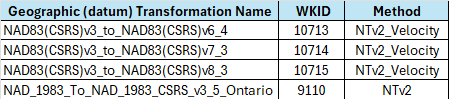 Transformations that could be leveraged from NAD83 > NAD83(CSRS)v3 > NAD83(CSRS) v6/7/8. Leveraging NTv2 and a second NTv2 Velocity Grid.
Epochs: One Important Limitation in ArcGIS
There is one important caveat to the ArcGIS Pro implementation of the velocity grid transformations. Although NTv2 velocity grids support transformations at different epochs, ArcGIS Pro currently supports transformations only at the anchor epochs of the CSRS realization. In practice, this is fine for the majority of GIS workflows. If you’re doing time-aware tectonic modelling, you’re probably not using GIS software anyway. Still, it’s something to be aware of if you are comparing results against the full desktop NRCan TRX tool.
Why Everything Uses the v80 Velocity Grid
If you’ve poked around the Esri Coordinate System Data installation folder, you might have noticed something interesting: ArcGIS installs three velocity grids:
- NAD83v6VG.gsb
- NAD83v70VG.gsb
- NAD83v80VG.gsb
Although all 3 are installed, only v80 is actually used. Why? This comes straight from the EPSG Geodetic Registry (and confirmation from Esri’s Bojan Savric): Transformations for CSRS v6 and v7 that used their matching velocity grids were superseded by newer transformation variants that always reference the latest velocity grid (v80). According to EPSG and NRCan: Users should use the most recent velocity grid, with older velocity grids retained only for backward compatibility. To note: CSRS v6, v7, and v8 all share the same anchor epoch (2010.0).
The result? Transformations from CSRS v3 to v6, v7, or v8 produce identical coordinates in ArcGIS Pro, and that is the expected behavior. So why include the older versions?
“users who wish to work with superseded transformations can create their own custom geographic transformations and ensure possible backward compatibility with older product releases, should we later add support for those superseded transformations”. ~ Esri’s Bojan Savric on Esri Forums
Final Thoughts
This is one of those changes that looks small on a release but is going to be critical as organizations update their datums over time. Even if you don’t plan to move from NAD83 (EPSG: 4269) to the NAD83(CSRS)v8 (EPSG: 10414) datum just yet, NATRF2022 is coming, and it is likely we are all headed in this direction.
FYI: GNSS correction services in Canada are already using epoch 2010 in most cases, so if you want to align other/older data with it, say NAD83, these transformations produce better (and different) results than the options in ArcGIS Pro 3.5 and earlier.
Final, final thought: No matter how you transform between datums, please don’t forget to document the transformation used. The software default transformation changes over different releases (first in the list), and no, we will not remember it in our GIS brains.
Updated final, final thought: This enhancement is also available in ArcGIS Enterprise v12.0! But no, you can’t use the new Coordinate System installer with older software versions as they can’t handle the velocity grids.
Helpful Links
Cover image: Photo by Simon Lee on Unsplash. April 08, 2026.

If you found my writing entertaining or useful and want to say thanks, you can always buy me a coffee.